






In the daily grind of an analytical lab, the HPLC tubing connector is one of those components that often gets overlooked—until it fails. It seems like such an insignificant, tiny piece of hardware, yet it is arguably one of the most critical consumables in your fluidic system. We’ve all been there: a simple leak ruins an entire day of analysis, or a spike in backpressure forces you to troubleshoot the whole flow path.
While it’s tempting to simply reorder replacements from your equipment manufacturer, the “official” branded options are often prohibitively expensive. But for many labs, the challenge isn’t just about the price tag; it’s about finding a reliable alternative that actually fits. How do you choose an aftermarket connector that guarantees a leak-free seal without compromising your system’s performance?
Choosing the right fitting isn’t guesswork. To make a smart decision, you need to balance three core factors: pressure requirements, material compatibility, and precision dimensions.
The first and most critical filter when choosing a connector is its pressure rating. Standard HPLC systems typically operate at pressures up to 6,000 psi (approx. 40–42 MPa), where standard PEEK or stainless steel fittings are usually sufficient. In contrast, higher-end analytical setups demand robust components rated between 25 MPa and 50 MPa (approx. 3,600 to 7,250 psi) to handle demanding solvent flows and resistance without failure. Never use standard low-performance polymer fittings on high-pressure pathways, even if the thread size matches.
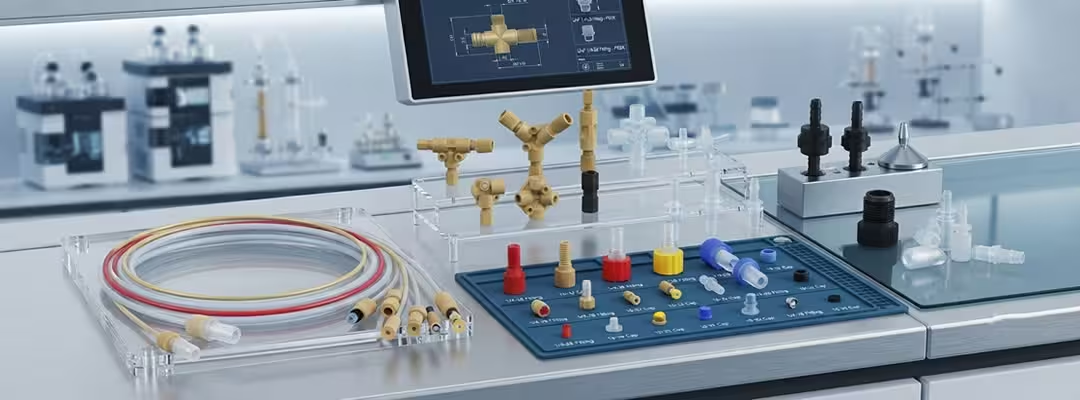
The choice of material directly affects chemical compatibility, reusability, and torque tolerance. PEEK is ideal for most routine HPLC applications and biocompatible systems because it offers finger-tighten convenience without wrenches and is chemically inert to common solvents. However, it can cold-flow under extreme continuous pressure. Stainless steel is necessary for high-pressure environments and extreme temperatures, providing maximum durability, though it requires a wrench to tighten and carries a risk of thread stripping or scratching port bottoms. For highly corrosive environments, specialty polymers like ETFE provide exceptional chemical inertness with balanced pressure thresholds.
Even the highest quality connector will leak or degrade chromatographic performance if the dimensions and geometry do not match your setup. Standard analytical HPLC tubing is almost universally 1/16-inch outer diameter, but maintaining low internal swept volumes requires carefully matching your tubing inner diameter. Furthermore, ensure your fittings account for coned port bottom variations across manufacturers like Waters, Agilent, or Shimadzu. True zero-dead-volume connections are essential to prevent mixing pools that cause peak broadening and ruin separation efficiency.
Finding cost-effective, high-performance HPLC connectors that match your exact pressure and compatibility needs doesn’t have to be a challenge. At Anhui Yixuan Precision Manufacturing, we specialize in high-reliability fluidic components and precision connectors designed to deliver OEM-level performance at a fraction of the cost. Whether you need standard PEEK fittings, high-pressure options up to 50 MPa, or custom solutions for your fluidic systems, our engineering team is here to help.
Contact us today via WhatsApp to discuss your specifications, request technical data sheets, or get a quick quote for your lab or distribution business.